

Custom AI agent development to boost your teams' productivity
companies supported
tailored











AI agents and automations built for your organisation
Have you identified AI use cases, but general-purpose tools like ChatGPT are not enough? Has an AI audit recommended automating repetitive tasks to free up your people's time?
Would you rather your teams built their own tools? Our Claude Code and Codex training teaches them to build with AI, on their own projects.
What is an AI agent for?
companies to boost productivity.

Meeting notes generation

Updating the
CRM

Enriching prospect records

Follow-up email after
a meeting

Sorting customer emails

Categorising invoices

Contract analysis

Social media moderation
Development
method







Scoping the business need
Analysis of use cases, definition of measurable goals and IT and regulatory constraints. → Deliverable: Experiment Canvas
Ideation and selection
Scoring of proposals, exclusion of high-risk cases, choice of the agents to build. → Deliverable: scoring table, list of selected agents
Prototyping
Proof of concept, using no-code tools wherever possible. → Deliverable: profile sheet for each agent (performance, costs, risks)
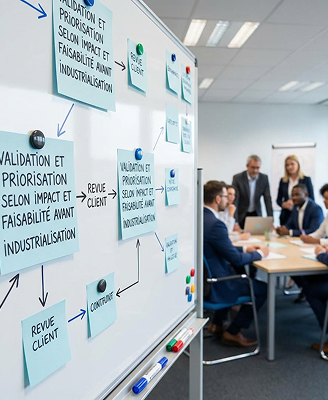
Client review #1
Validation and prioritisation by impact and feasibility before scaling up.
→ Deliverable: decision deck, agents to scale up
Scale-up strategy
Scaling up and operational roadmap.
→ Deliverable: scale-up plan and Agent Card for each agent
Client review #2
Validation of rollout strategies, KPI measurement.
→ Deliverable: decision deck and security checklist
Rollout and optimisation
Gradual rollout, quality control and performance tracking.
→ Deliverable: operational dashboard
How do you deploy AI agents
in a company?
Simplicity
We only build when general-purpose tools are not enough. Our method favours simple automations to keep risk low and ROI high.
Experimentation
Prototyping and validation are part of our culture. The performance of every version of an agent is checked and measured before rollout.
ROI
Low-risk, high-impact use cases are identified and handled first to maximise return on investment.
Our AI
consulting services




AI use case audit
We analyse your business processes to identify high-impact generative AI opportunities. Our in-depth audit gives you a clear, prioritised, actionable roadmap to transform your organisation with measurable gains.

Change management
We support your teams over time to ensure adoption and skills growth. AI committees, usage tracking, continuous improvement: we turn your technology investment into lasting operational success.
AI licence management

We buy and manage your ChatGPT, Claude, Copilot or Mistral licences: setup and security (SSO, MFA, GDPR DPA), dedicated user support and usage tracking. You get a single invoice, in euros.
Frequently
asked questions
Why build an AI agent rather than use ChatGPT?

A custom AI agent is only justified in three situations: when you need access to your internal data (CRM, ERP), when you need to automate complex workflows across several tools, or when you need compliance guarantees that general-purpose tools cannot provide. In every other case, we recommend general-purpose tools such as ChatGPT or Claude, which are often better suited and cheaper.
What are the main reasons AI agent projects fail?
The main reasons are over-ambition at launch (trying to build fully autonomous agents from day one), a lack of good-quality data to feed the agent, users not adopting it, and maintenance needs that are consistently underestimated. Our step-by-step approach and mandatory POC greatly reduce these risks.
What is a "supervised" AI agent?
A supervised agent is an AI agent that requires human approval before any critical action, which ensures the highest level of safety. It can be set with a confidence threshold that calls in a human when the AI is unsure of its decision. For example, sending an important email or triggering a payment will always require manual approval.
Which no-code tools do you use?
We mainly use Zapier, Make, n8n and Power Automate. The choice of platform depends on your use case, the integrations needed with your existing tools and your technical constraints.
What is a POC and why is it mandatory?
A POC (proof of concept) is a working prototype that validates the technical feasibility of the project, the quality of the results and user acceptance. It is mandatory for every complex agent project before investing in full development, because it quickly reveals potential obstacles and lets us adjust the approach if needed.
Do you offer maintenance after development?
Yes, we offer full maintenance: technical support, performance monitoring, continuous improvement based on real usage data, minor changes and the technology updates needed to keep your agent performing over time.
How do you ensure security and GDPR compliance?
We set up a secure architecture with strict access control, full logging of every action the agent takes, and full GDPR compliance. If your constraints require it, we also offer hosting in France to keep your data sovereign.
Do you build fully autonomous agents?
No, we do not build fully autonomous agents. 95% of complex autonomous agent projects fail, because the technology is not yet mature enough to guarantee reliable full autonomy. We only build supervised agents with human approval, which strike the right balance between automation and safety.
How are you different from traditional consulting firms?
Unlike traditional firms that routinely sell costly custom development (with a 95% failure rate), we take a gradual, pragmatic approach. We first recommend general-purpose tools, then no-code solutions if needed, and only propose custom development as a last resort, when your needs truly justify it.


